
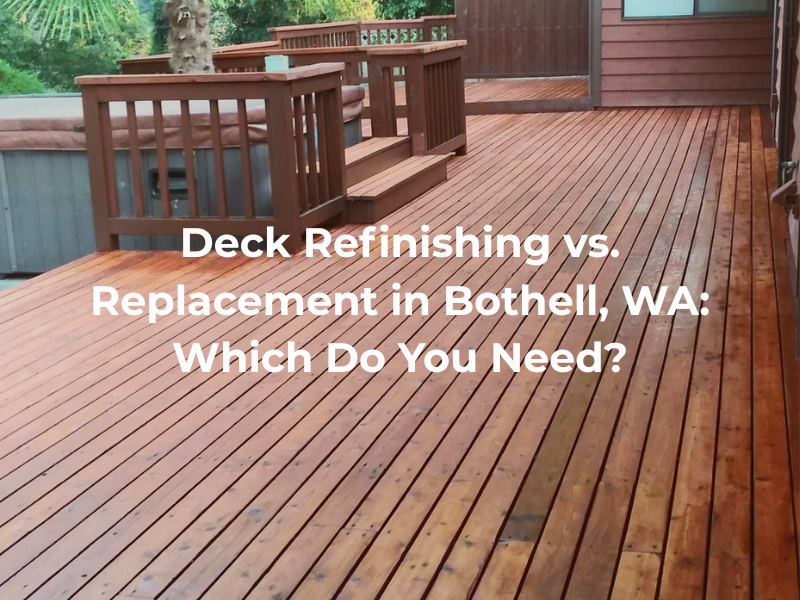
Deck Refinishing vs. Replacement in Bothell, WA: Which Do You Need?
Your deck in Bothell is showing its age faded stain, soft spots, algae film after every wet season. Before you spend a dollar, you need the answer to one question: can this deck be refinished, or has it reached the point where replacement is the smarter money? Getting this wrong is expensive in both directions. Refinishing a deck that’s structurally gone wastes the whole investment; replacing a deck that only needed refinishing burns thousands you didn’t have to spend.
Refinish or Replace? How to Tell Which One Your Bothell Deck Needs
The deciding factor isn’t how bad the surface looks surfaces almost always look worse than the deck actually is. What matters is the structure underneath: joists, ledger board, posts, and how much sound wood the boards have left.
Deck refinishing is the full process: stripping old finish, sanding the surface back to clean wood, repairing any damaged boards, and applying fresh stain and sealant. It’s a reset not a patch job. Deck staining is one step within refinishing; it adds color and UV protection. Sealing adds a moisture barrier. Deck restoration goes a step further when wood is heavily weathered or structurally compromised it may include board replacement and deeper structural repair before refinishing begins.
Here’s the simplest way to think about it:
- Refinishing is the right call when → the structure is sound and the damage is surface-level: graying, faded stain, cracked finish, algae, or minor splintering. This is the majority of Bothell decks.
- Restoration plus refinishing fits when → boards are cupped or heavily weathered and a few need replacing, but posts, joists, and the ledger are still solid. You replace the bad boards and refinish the whole deck.
- Full replacement is the honest answer when → the framing is compromised: soft or rotted joists, a failing ledger board, posts with rot at the base, or widespread board failure. No finish fixes structure.
In Bothell’s climate that line gets crossed faster than most homeowners expect. From November through March your deck absorbs rain almost daily; wood that stays wet feeds rot in the framing where you can’t see it. That’s why the inspection matters more than the quote.
The good news: in our experience, most Bothell decks that homeowners assume are beyond saving are structurally fine and only need refinishing often at a fraction of replacement cost. The rest of this guide covers how to check, what the refinishing process actually involves, and when to bring in a professional.
The Step-by-Step Process: How to Refinish a Deck (DIY Overview)
Refinishing a deck is a real project. It takes time, the right materials, and patience. Here’s an honest overview of what the process involves both for homeowners considering DIY and for those who want to understand what professionals do on their behalf.
- Inspection and Planning
Before anything else, you need to evaluate the deck’s actual condition. Walk it carefully. Press a screwdriver into the wood at the ledger board, posts, and anywhere you see discoloration or soft spots. Soft wood means rot and rot changes everything. If you find rot in structural members, you’re looking at board replacement before refinishing begins, not after.
Check for:
- Loose or popped fasteners
- Warped or cupped boards
- Mold or mildew growth (common in Bothell’s damp conditions)
- Peeling or flaking old finish
If the damage is limited to surface weathering and cosmetic wear, DIY refinishing may be realistic. If you’re finding soft wood, significant mold, or structural movement, call a professional before you invest in materials.
Pro Tip: Before you buy a single product, photograph your deck in sections top-down, close-up of any soft spots, and the underside of the framing if accessible. These photos help a professional give you a far more accurate assessment over the phone, and they give you a reference point for tracking the deck’s condition year over year.
- Gathering Materials and Safety Equipment
A proper refinishing project requires more than a brush and a can of stain. You’ll need a deck cleaner, a sander or sanding discs rated for your wood type, protective gear (gloves, eye protection, respirator), stain or deck solids appropriate for your wood species, and sealant. Never skip the respirator sanding old finish releases fine particles that are a real respiratory hazard.
Pro Tip: In Bothell’s climate, product selection matters more than most homeowners realize. The wrong stain formulation won’t bond correctly to wood that has residual moisture content above 15–18%. A professional will test moisture levels before applying anything. If you’re going DIY, buy a moisture meter it’s not optional here.
- Cleaning and Preparation
This is where most DIY projects either succeed or fail before the real work begins. The deck surface needs to be thoroughly cleaned with a deck wash solution, then rinsed completely. Allow adequate drying time and in Bothell, “adequate” means more time than the product label suggests, because ambient humidity slows surface drying.
Protect adjacent siding, landscaping, and anything beneath the deck from chemical runoff. Mask off areas carefully. Move furniture and planters completely off the surface not to the edges.
- Sanding
Sanding is the core of refinishing. It opens the wood grain, removes old finish residue, and creates the surface profile that allows the new stain to penetrate correctly. This step represents the majority of the physical work and the majority of refinishing errors trace back to it.
Sand with the grain. Always. Cross-grain sanding leaves visible scratches that show through the finished stain. Use the correct grit progression for your wood: starting too coarse damages softer species like cedar; starting too fine won’t cut through weathered hardwoods.
Pro Tip: If your deck has cedar boards which is common in Bothell and throughout King County be careful with aggressive sanding. Cedar is a relatively soft wood and can develop fuzzing if over-sanded. A light touch with the right grit leaves a clean surface that accepts stain evenly.
- Applying Stain and Deck Solids
Once the surface is clean, dry, and sanded, it’s time to apply the right product. The choice between a semi-transparent stain and deck solids depends on the wood’s condition and how much you want to mask the grain. Semi-transparent stains show the wood’s natural character; deck solids provide more coverage for weathered or inconsistent surfaces.
Apply in the direction of the grain. Work in manageable sections to maintain a wet edge and prevent lap marks. Two coats are typically necessary for proper coverage and protection. Don’t rush between coats allow full penetration of the first coat before applying the second.
- Drying, Curing, and Return to Use
This is where patience pays off. Drying (surface dry to the touch) and curing (full chemical hardening) are two different things. A deck may feel dry within hours but won’t be fully cured for a week or more. Foot traffic on an under-cured finish causes scuffing and premature wear.
Pro Tip: Bothell’s average humidity runs between 60–75% year-round and higher during the fall and winter months. That moisture in the air slows curing significantly. We always allow extra curing time on projects here before recommending full use. Rushing this phase undoes every hour of prep and application work that came before it.
Common Mistakes DIYers Make (And Why Professionals Avoid Them)
Even capable, motivated homeowners run into problems when refinishing a deck for the first time. These aren’t rare edge cases they’re patterns we see consistently after 30+ years in King County and Snohomish County.
Underestimating Preparation Time
The most common mistake is also the most predictable. Homeowners plan for the fun part applying fresh stain, watching the deck transform and underestimate how long cleaning and sanding actually takes. A 12×16 deck done correctly requires serious hours of prep work. When prep gets rushed, the stain doesn’t penetrate correctly, adhesion fails, and the finish starts peeling within a season.
What professionals do instead: Budget time for prep first, then everything else. The quality of the finished product is determined before a single drop of stain touches the wood.
Making Wrong Assumptions About Wood Type
Not all decks are the same. Cedar, pressure-treated wood, and composite materials each behave differently under sanding, respond to different products, and require different application techniques. Applying a product formulated for one wood type to a different species can cause poor absorption, discoloration, or premature failure.
What professionals do instead: Identify the wood species and condition before selecting materials. In the Pacific Northwest, cedar and pressure-treated wood are the most common and they have meaningfully different refinishing requirements.
Skipping Rot and Damage Inspection
A fresh coat of stain over rotting wood is the most expensive mistake a homeowner can make. It looks fine on day one. Within months, the finish fails, the rot accelerates underneath, and what could have been a board replacement becomes a full structural repair.
What professionals do instead: Inspect every board, every post connection, and every ledger attachment before any surface work begins. Structural integrity is non-negotiable.
Sanding Unevenly
Uneven sanding creates a surface with inconsistent porosity. Areas that are over-sanded absorb more stain; areas that are under-sanded resist it. The result is a blotchy, patchy finish that looks worse than the weathered deck you started with.
What professionals do instead: Use systematic sanding patterns, consistent pressure, and check the surface in raking light before moving to the next phase. You can’t fix uneven sanding after the stain is down.
Ignoring Moisture Barriers in the PNW
Applying sealant over wood that hasn’t fully dried or using a product that isn’t rated for high-humidity environments traps moisture beneath the surface. In Bothell’s climate, that trapped moisture becomes a mold problem. Fast.
What professionals do instead: Test wood moisture content before application and select products specifically formulated for Pacific Northwest conditions. There’s no one-size-fits-all approach in a climate like ours.
Applying Stain in the Wrong Conditions
Direct sunlight heats the wood surface and causes stain to dry too quickly on the surface before it penetrates. Applying in temperatures below the product’s minimum rating causes adhesion failure. Most product labels include application windows and most DIYers skip past them.
What professionals do instead: Schedule application for overcast days or shaded windows when surface temperature is stable. In Bothell, this is actually easier than in sunnier climates but it still requires planning around weather.
When to Hire a Professional for Refinishing a Deck in Bothell
The DIY overview above is honest about what the process involves. But there’s a second audience reading this guide: homeowners who’ve done the inspection, assessed the scope, and are thinking seriously about hiring someone. This section is for you.
When Professional Refinishing Makes the Most Sense
DIY refinishing is realistic when the deck is structurally sound, the old finish is simply worn, and the homeowner has time, access to equipment, and the patience to do prep work correctly. That’s a real scenario and we respect it.
Professional refinishing makes more sense when:
- Rot or structural damage is present. Board replacement and structural repair before refinishing requires professional judgment and proper tools. Getting it wrong means compounding the problem.
- The deck is large or complex. Multi-level decks, built-in seating, and tight angles multiply the prep time and the margin for uneven application. Professionals manage these with established workflows.
- Previous DIY work failed prematurely. When a finish has peeled within a season, there’s usually a prep or product issue underneath. Correcting it correctly not just covering it again requires diagnosis, not just effort.
- You want a documented, warrantied result. A licensed, bonded professional carries liability coverage and stands behind the work. No DIY project comes with that protection.
- Bothell’s climate is a known variable on your deck. North-facing surfaces, heavy tree canopy, moisture-retaining configurations these are factors a professional with local experience accounts for in material selection and scheduling. A general contractor unfamiliar with PNW conditions may not.
What Professional Refinishing Actually Includes
When you hire Deck Refinishing LTD for a Bothell deck, the process isn’t just “apply stain faster.” It includes a full inspection before any surface work begins, moisture testing prior to application, mold-prevention treatment as part of preparation, climate-appropriate product selection, and scheduled curing time that accounts for Bothell’s ambient humidity.
We’ve been licensed and bonded and have worked in this specific market for over 30 years. That’s not a marketing line it’s the difference between a process calibrated for Pacific Northwest conditions and a generic approach that may not hold through a Bothell winter.
Learn more about our full process here
Deck Refinishing Cost in Bothell, WA: What to Budget
Let’s be straightforward about this: there’s no universal number for refinishing a deck in Bothell. Every deck is different different size, different wood species, different condition, different level of prep required. Any estimate you get without a physical inspection of your specific deck isn’t a real estimate.
That said, here’s what drives cost whether you’re doing it yourself or hiring a professional:
For DIY projects, the variables include deck cleaner, sanding equipment or rental, stain and deck solids (quantity depends on deck size and product coverage rate), and protective materials. Factor in your time honestly this is not a weekend afternoon project. If mistakes require redoing any phase, material costs multiply.
For professional refinishing, the investment reflects the full scope: inspection, professional-grade materials, skilled labor, climate-appropriate application techniques, and a finished result that lasts. Licensed, bonded professionals also carry liability insurance which matters when the work is being done on your home.
The real cost comparison that homeowners miss: A DIY refinish done incorrectly often requires professional correction within a season or two. That means paying twice once for materials, and again for professional repair. The economics of “saving money” on DIY disappear quickly when the finish fails prematurely.
| Factor | DIY | Professional |
| Material costs | Your expense | Included |
| Equipment | Rental or purchase | Owned |
| Time investment | Significant | 2–4 days |
| Product warranty | None | Per product |
| Workmanship warranty | None | Yes |
| Risk of redoing work | High | Minimal |
| Liability coverage | None | Licensed & bonded |
Low-competition opportunity for Bothell homeowners: Searches for “deck refinishing cost Bothell, WA” and “refinishing deck cost Bothell, WA” are relatively low in paid competition — meaning you’ll find less advertising noise and more opportunity to connect with genuine local professionals who aren’t just running Google Ads.
For an accurate estimate on your specific deck, the only real answer is an on-site inspection. We offer free estimates just call (800) 953-9370 and we’ll schedule a time that works for you.
Bothell’s Climate Challenge: Why Professional Refinishing Matters Here
Bothell isn’t Seattle. It’s wetter, it holds humidity differently, and if you’re north of the downtown core toward Canyon Park or Thrasher’s Corner, you’re in a micro-climate that gets more sustained moisture than the regional averages suggest. This isn’t a knock on Bothell it’s a genuinely beautiful part of King County. But that climate is relentless on exterior wood.
Here’s what the Pacific Northwest does to an unprotected or poorly refinished deck:
Sustained humidity from October through April keeps wood moisture content elevated for months at a time. Wood that can’t dry out fully between wet periods begins to cup and warp. The cellular structure of the wood responds to the repeated swelling and shrinking by developing micro-cracks and those cracks are entry points for water and mold.
Temperature swings between seasons not extreme, but consistent put real stress on finish adhesion. A sealant that didn’t bond correctly in the first place won’t survive a Bothell winter in good condition.
Mold and mildew growth accelerate in conditions where shade, moisture, and organic debris (leaves, pine needles) combine on the deck surface. This is common throughout the Bothell area, particularly on north-facing decks or those with tree coverage. A surface coat of stain won’t stop mold from growing underneath if the wood wasn’t properly cleaned and treated before application.
What professional refinishing does differently in this climate:
A professional with experience in Bothell and King County selects materials that are specifically rated for high-humidity environments. They test wood moisture levels before application not as an optional step, but as a standard part of the process. They apply mold-prevention treatments as part of the preparation phase. And they schedule the work around weather windows that give the finish the best possible conditions for curing.
This is where the difference between a professional who works in the Pacific Northwest and a general contractor becomes meaningful. Our climate has specific demands. The right approach here is not the same as the right approach in Arizona or North Carolina.
A real-world example from our Bothell service area:
We’ve worked with homeowners who had their decks refinished by someone unfamiliar with PNW conditions. The stain looked good initially. Within eight months, the finish was peeling, mold was growing at the board edges, and the wood beneath had begun to show the early signs of moisture damage. What should have been a refinish became a restoration with board replacement required in the worst sections.
The original refinishing cost them time and money. The restoration cost them significantly more. The gap between those two outcomes comes down to climate awareness, material selection, and preparation quality.
Pro Tip: In Bothell, north-facing deck surfaces are the highest-risk zones for mold and finish failure. If your deck faces north or sits under significant tree canopy, mention that specifically when you call for an estimate. It changes the product selection and the application approach and it’s something we factor into every job we evaluate in this area.
Why Deck Refinishing LTD Is the Right Choice for Your Bothell Deck
There’s no shortage of contractors who will give you a quote on refinishing a deck in Bothell. Here’s what makes the conversation different when you call Deck Refinishing LTD.
We are not a franchise. We’re not a national company that subcontracts to whoever is available this week. We’re a family Pete, John, Mynor, and Mike and we’ve been working in King County and Snohomish County continuously since Pete founded the business. The story starts in 1991 as Pete’s Pressure Washing, grew into deck specialization when Pete’s father John joined in 1993, and became Deck Refinishing LTD when we incorporated in 1995. That’s the same family, the same geographic market, the same obsession with getting the work right for over 30 years.
What that means for you as a Bothell homeowner:
We know the neighborhoods. We know which micro-climates hold moisture longest. We know how the homes in Canyon Park and Westhill differ from the decks closer to the waterfront along the Sammamish River corridor. That local knowledge isn’t something you can manufacture it comes from 30+ years of showing up and doing the work in the same communities.
We are licensed and bonded (License #MHPAIPD903K). That’s not a footnote it’s the baseline of professional accountability. If something goes wrong on your property, you’re protected. Many deck contractors operating in the Bothell area are not licensed. That’s your risk to carry if you hire them.
We offer free estimates and 24/7 availability for scheduling and questions. We know that homeowners don’t always notice deck problems during business hours and we make it easy to reach us when it matters.
We specialize. Deck refinishing and wood restoration is what we do. Not general painting, not interior work, not whatever job comes along. Our entire process from inspection to final coat is built around exterior wood in Pacific Northwest conditions. That focus shows in the results.
If you’re searching for “deck refinishing near me Bothell, WA” or “deck refinishing contractors Bothell, WA,” we’d ask you to do one thing: call us before you decide. Get a free estimate. Ask us about your specific deck. The conversation costs nothing, and it gives you a clear picture of what your deck actually needs not a sales pitch, but a professional assessment from people who’ve been doing this work in your region for over 30 years.
Call us at (800) 953-9370 or email Info@DeckRefinishingLTD.com to schedule your free deck inspection and estimate. We serve Bothell and surrounding King County and Snohomish County communities.
Frequently Asked Questions: Refinishing a Deck in Bothell, WA
How often should I refinish my deck in Bothell? It depends on the wood type, the finish applied, and how much sun and moisture exposure your deck gets. In Bothell’s climate, a professionally refinished deck benefits from re-staining every other year or yearly as maintenance, with a full refinishing cycle as the surface condition requires. Regular maintenance extends the time between full refinishing projects and protects the wood investment in between.
Can I refinish a deck myself in the Pacific Northwest? Yes with the right preparation, materials, and realistic expectations about time. The PNW climate adds complexity: moisture testing, longer curing windows, and mold-prevention steps that aren’t always described on product labels. Many homeowners successfully refinish their own decks. Many also call us after a DIY result that didn’t hold up through a Bothell winter.
What’s the difference between deck staining and deck refinishing? Staining is one phase within refinishing. Full refinishing includes cleaning, sanding, repair (including board replacement where needed), and then staining and sealing. Staining alone is appropriate when the existing surface is still in good condition and just needs a color refresh. Refinishing is needed when the old finish has failed, the wood has weathered, or surface damage is present.
Do you refinish composite decks? Composite decking has different maintenance requirements than wood and most composites are not refinished the same way. If you have a composite deck in Bothell and are concerned about its appearance or condition, call us for an evaluation. We’ll give you an honest assessment of what options make sense for your specific decking material.
How do I know if my deck needs refinishing or replacement? The short answer: if the structure is sound, refinishing is almost always the better option. If you have significant rot in posts, beams, or joists, or if boards are so degraded they can’t hold a finish, you’re looking at restoration work that includes board replacement before refinishing. A professional inspection tells you exactly where you stand and we offer that inspection at no charge.
Are you licensed and insured for deck refinishing in Bothell, WA? Yes. Deck Refinishing LTD is licensed and bonded (License #MHPAIPD903K) and has been serving King County and Snohomish County for 30+ years. We carry full liability coverage. Always verify licensing before hiring any contractor for exterior work on your home.
Ready to give your Bothell deck the attention it deserves?
Call (800) 953-9370 available 24/7. Free estimates. Licensed & bonded. 30+ years serving Bothell, Kirkland, and King County.
Or reach us by email at Info@DeckRefinishingLTD.com.


